All About ASP.NET and ASP.NET Core 2 Hosting BLOG

Tutorial and Articles about ASP.NET and the latest ASP.NET Core

ASP.NET Hosting - ASPHostPortal.com :: Describes Caching Methods In ASP.NET

clock February 5, 2015 06:45 by author Mark

Today I will describes caching methods in ASP.NET. It's a good habit to use caching in your application and coding standards too.

Overview

Caching is one of the most interesting concepts and operations in ASP.NET. If you can handle it, you can run any web application by applying the caching concept depending on the requirements.
Currrently a majority of websites/portals (or I can say simply web pages) are dynamic (if I do talk about a dynamic website, then it doesn't mean all the pages of that website is dynamic or will be. The probability of happening this is dependent on the user's perspective and the requirements).
In veru common words I can define dynamic pages as including the following:

  • Pages that directly interact with people
  • Communication (on page)
  • Any media content
  • Any Type of grafic Interaction

So, generally these types of pages or webs are called dynamic. Now let's find why we really need caching.

Why Caching

Caching is for providing solutions or the results to the users depending on their requested request, admin needs to recreate the pages often depending on user requests…STOP!!!

The process

The process is quite bulky and time-consuming. So to overcoming that problem some websites have a page creation engine that automatically creates all the pages in one action and directly saves those pages as a HTML structured page. These HTML pages serve the user depending on their requirements.

Multiple sorts of pages

But, do you still think this will be enough? If your answer is yes, then please think some more!
Actually, the preceding solution will only work if and only if the requested pages are of the same type. Now think, what will happen if the users request a different sort of page?
In that case your web will be stuck again.
So for dealing with that kind of complex but necessary requirements, ASP.NET provides support for caching. Caching is the hero/heroine in this context that will help us to a great extent.

What a Cache does

What a cache does, in the most simple words I can say is:
"A cache simply stores the output generated by a page in the memory and this saved output (cache) will serve us (users) in the future." That's it.

Types
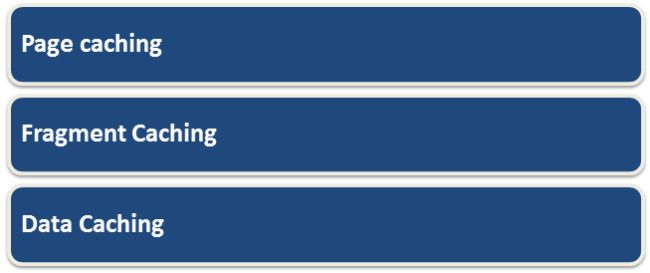
Page Caching

Let's explore the caching of an entire page, first.
To cache an entire page's output we need to specify a directive at the top of our page, this directive is the @ OutputCache.
Let's figure out a simple demo of it.

<%@ OutputCache Duration = 5 VaryByParam = "ID" %> 

Here, in that statement Duration and VarByParam are the two attributes of the OutputCache directive. Now let's explore how they work.

  • Duration Attribute : This attributes represents the time in seconds of how long the output cache should be stored in memory. After the defined duration the content stored in the memory will be cleared automatically.
  • VarByParam Attribute : This is the most important attributes; you can't afford to miss that in the OutputCache directory statement. It generally defines the query string parameters to vary the cache (in memory).

You can also pass multiple parameter names too, but for that you need to separate them using a semicolon (;).
You can also specify it as "*". In this case the cached content is varied for all the parameters passed using the querysrting.
For example:

<%@ OutputCache Duration = 5 VaryByParam = "*"%> 

In case of caching a page, some pages can generate different content for different browsers. In that scenario we need to add an additional attribute to our statement for overcoming the preceding problem.
For example:

<%@ OutputCache Duration = 5 VaryByParam = "ID" VaryByCustom = "Browser" %> 

Or:

<%@ OutputCache Duration = 5 VaryByParam = "*" VaryByCustom = "Browser" %>

Fragment caching

In some scenarios we only need to cache only a segment of a page. For example a contact us page in a main page will be the same for all the users and for that there is no need to cache the entire page.
So for that we prefer to use fragment caching option.
For example:

<%@ OutputCache Duration = 10 VaryByParam = "None" %> 

Or:

<%@ OutputCache Duration = 5 VaryByParam = "None" VaryByCustom = "Browser" %> 

Data Caching

Data caching is slightly different from the 2 other caching types. It's much more interesting to see how data caching actually works.
As we know in C# everything is about classes and objects. So ASP.NET supports data caching by treating them as small sets of objects. We can store objects in memory very easily and use them depending on our functionality and needs, anywhere across the page.
Now you must be thinking where is the class in that entire scenario?
Actually, this feature is implemented using the Cache class and data is treated as its object. Let's see how it works using a demo.

I am inserting a string value in the cache as:

Cache["Website"] = "CSharpCorner"; 

Now, for inserting the cache into the objects, the insert method of the Cache class can be used. This insert method is used as follows:

Cache.Insert("Website", strName, 
new CacheDependency(Sever.MapPath("Website.txt")); 

What we are missing something
We missed the Time for the cache (don't forget to use it), let's provide it:

Cache.Insert("Website", strName, 
new CacheDependency(Sever.MapPath("Website.txt") 
DateTime.Now.Addminutes(5), TimeSpan.Zero); 

Happy coding!

TOP No#1 Recommended ASP.NET Hosting

ASPHostPortal.com

ASPHostPortal.com  is the leading provider of Windows hosting and affordable ASP.NET Hosting. ASPHostPortal proudly working to help grow the backbone of the Internet, the millions of individuals, families, micro-businesses, small business, and fledgling online businesses. ASPHostPortal has ability to support the latest Microsoft and ASP.NET technology, such as: WebMatrix, WebDeploy, Visual Studio 2015, .NET 5/ASP.NET 4.5.2, ASP.NET MVC 6.0/5.2, Silverlight 6 and Visual Studio Lightswitch, ASPHostPortal guarantees the highest quality product, top security, and unshakeable reliability, carefully chose high-quality servers, networking, and infrastructure equipment to ensure the utmost reliability.


ASPHostPortal.com Announces Fast Kentico 8.2 Hosting Solution

clock February 3, 2015 11:27 by author Dan

Supported by professional teams, ASPHostPortal has been gaining more and more user’s recognition. We offers 4 main packages with different prices. All the packages include large bandwith, large disk space, latest ASP.NET technology, free data backups, uptime guarantee, dedicated application pool and much more. Today, we launch Kentico 8.2 hosting with superior technology and affordable price.

Kentico CMS is a web content management system (WCMS) for building web sites, on-line stores, intranets and Web 2.0 community sites. Kentico is being used by more than 16,000 Web sites in 90 countries. Kentico CMS utilizes ASP.NET and Microsoft SQL Server. Kentico allows development via its portal engine or using Visual Studio. Kentico is also compatible with Microsoft Windows Azure Platform.

Kentico 8.2 featuring several new collaboration and ecommerce enhancements that make launching and managing digital marketing campaigns faster and easier than ever. The latest product enhancements include:

Bi-Directional SharePoint Synchronization
all changes made in Kentico will be made automatically on the SharePoint server. Just point and share the files are always up to date, and everyone has the latest versions.

Easy Shipping Calculations
Everyone can now easily create a shipping module (and reuse for other projects) that presents all the tools that need to calculate shipping costs in custom user interface.

Enhanced Contact Management
Everyone can easily import Contacts from a CSV file, segment them, and leverage them in the system.

With more than 1 million followers, ASPHostPortal is an expert in the hosting market. We provide Kentico 8.2 Hosting only from $5/month with 30 days money back guarantee. In addition, we have been awarded as one of the fastest hosting companies in the industry because of the good hosting performance our web host provides. To provide fast hosting speed, we utilize 6 state-of-the-art data centers located on the USA, Netherlands, Singapore, France, United Kingdom and Australia. To learn more about Kentico 8.2 Hosting, please visit http://asphostportal.com/Kentico-8-2-Hosting

About ASPHostPortal.com :
ASPHostPortal.com is The Best, Cheap and Recommended ASP.NET Hosting. ASPHostPortal.com has ability to support the latest Microsoft and ASP.NET technology, such as: such as: WebMatrix, WebDeploy, Visual Studio 2015, .NET 5/ASP.NET 4.5.2, ASP.NET MVC 6.0/5.2, Silverlight 6 and Visual Studio Lightswitch. ASPHostPortal include shared hosting, reseller hosting, and sharepoint hosting, with speciality in ASP.NET, SQL Server, and architecting highly scalable solutions. ASPHostPortal.com strives to supply probably the most technologically advanced hosting solutions available to all consumers the world over. Protection, trustworthiness, and performance are on the core of hosting operations to make certain every website and software hosted is so secured and performs at the best possible level.


ASP.NET MVC Hosting - ASPHostPortal.com :: How to Create Various Charts for ASP.NET MVC Applications

clock February 3, 2015 06:02 by author Mark

How to Create Various Charts like Line, Column, Area and Pie for ASP.NET MVC Applications.

In this article we will see how to create various charts like Line, Column, Area and Pie for ASP.NET MVC applications. In this article we will use a third party chart control so you will also learn how to use the third party control in ASP.Net MVC application. In my last two articles i.e. Display Graph in ASP.NET MVC and Charts for Asp.Net Application you saw how to prepare the chart/graph for ASP.Net and ASP.Net MVC. Charts for Asp.Net Application here I'm using some third party chart control to prepare the chart for ASP.Net. In this article also I'm using the same chart control with a MVC application. In a normal ASP.Net application all of you are aware of using third party controls in your application but in MVC it is slightly different.
In this article we will create four different kinds of charts as mentioned below.

  • Line Chart
  • Column Chart
  • Pie Chart
  • Area Chart

Step 1 :  For creating these various charts in our application we use the WebChart.dll file so simply download the attachment and add the reference to your project.
Step 2 : Add the controller Home in your project and write the different methods for calling different charts like below.

public ActionResult Index()
       {
             return View();
        }
        public ActionResult Line()
        {
            return View();
        }
        public ActionResult Area()
        {
            return View();
        }
        public ActionResult Pie()
        {
            return View();
        }
        public ActionResult Column()
        {
            return View();
        }

Step 3 : Now add the View for index and keep the Action links for calling different methods in Home controller like below.

<%=Html.ActionLink("Line Chart","Line") %>
<%=Html.ActionLink("Area Chart","Area") %>
<%=Html.ActionLink("Pie Chart","Pie") %>
<%=Html.ActionLink("Column Chart","Column") %>

Step 4 : First, on the top of the page, register one tag prefix to refer to the WebChart.dll and import the namespaces i.e. WebChart and System.Drawing like below.

<%@ Register TagPrefix="Web" Namespace="WebChart" Assembly="WebChart" %>
<%@ Import Namespace="WebChart"%>
<%@ Import Namespace="System.Drawing"%>

Step 5 : In the head section of your view write the following script.

<script runat="server">
        protected void Page_Load(object sender, EventArgs e)
        {
            if (!IsPostBack)
            {              
                AreaChart chart = new AreaChart();
                chart.Fill.Color = Color.FromArgb(50, Color.SteelBlue);
                chart.Line.Color = Color.SteelBlue;
                chart.Line.Width = 2;
                chart.Legend = "The Legend What You Want";
                //can pull the values from database             
                chart.Data.Add(new ChartPoint("Vulpes", (float)System.Convert.ToSingle(350)));
                chart.Data.Add(new ChartPoint("SP Nayak", (float)System.Convert.ToSingle(185)));
                chart.Data.Add(new ChartPoint("Krishna", (float)System.Convert.ToSingle(55)));
                chart.Data.Add(new ChartPoint("Datta Kharad", (float)System.Convert.ToSingle(40)));
                chart.Data.Add(new ChartPoint("Jignesh Trivedi", (float)System.Convert.ToSingle(30)));
                chart.Data.Add(new ChartPoint("Prabhu Raja", (float)System.Convert.ToSingle(25)));
                ConfigureColors();
                ChartControl1.Charts.Add(chart);
                ChartControl1.RedrawChart();
            }
        }
        private void ConfigureColors()
        {
            ChartControl1.Background.Color = Color.FromArgb(75, Color.SteelBlue);
            ChartControl1.Background.Type = InteriorType.LinearGradient;
            ChartControl1.Background.ForeColor = Color.SteelBlue;
            ChartControl1.Background.EndPoint = new Point(500, 350);
            ChartControl1.Legend.Position = LegendPosition.Bottom;
            ChartControl1.Legend.Width = 40;
             ChartControl1.YAxisFont.ForeColor = Color.SteelBlue;
           ChartControl1.XAxisFont.ForeColor = Color.SteelBlue;
             ChartControl1.ChartTitle.Text = "C-Sharpcorner Current Months Runner Up";
            ChartControl1.ChartTitle.ForeColor = Color.White;
             ChartControl1.Border.Color = Color.SteelBlue;
            ChartControl1.BorderStyle = BorderStyle.Ridge;
        }
    </script>

In the above code we have populated the chart control by adding chart points. You can add your own chart points. This Webchart.dll provides the different types of charts we discussed above so according to your view make a change in the first line under page load by creating different classes instance of chart type e.g.:

For Area Chart use

AreaChart chart = new AreaChart();

For Line Chart use

LineChart chart = new LineChart();

In the above code you only have to make these changes for creating your own choice chart also you can configure the colors as you need and you can create the points i.e. chart point per your requirement.

Step 6 : Add four views with each chart type by replacing the classes of WebChart. Now run your application and see the results.

Conclusion

It is quite simple to create various types of charts for our ASP.Net MVC applications.

TOP No#1 Recommended ASP.NET MVC Hosting

ASPHostPortal.com

ASPHostPortal.com  is the leading provider of Windows hosting and affordable ASP.NET MVC Hosting. ASPHostPortal proudly working to help grow the backbone of the Internet, the millions of individuals, families, micro-businesses, small business, and fledgling online businesses. ASPHostPortal has ability to support the latest Microsoft and ASP.NET technology, such as: WebMatrix, WebDeploy, Visual Studio 2015, .NET 5/ASP.NET 4.5.2, ASP.NET MVC 6.0/5.2, Silverlight 6 and Visual Studio Lightswitch, ASPHostPortal guarantees the highest quality product, top security, and unshakeable reliability, carefully chose high-quality servers, networking, and infrastructure equipment to ensure the utmost reliability.


ASP.NET Hosting - ASPHostPortal.com :: Sending an email using exchange server from the ASP.NET Application

clock February 2, 2015 07:27 by author Dan

The .NET Framework 1.x had a System.web.mail class to send an email from the ASP.NET system. While this namespace and these classes still exist in the .NET Framework form 2.0 and later, they have been expostulated and supplanted by the new Mail API in the System.net.mail namespace in the Asp.net 2.0 structure. Asp.net 1.x's System.web.mail API was focused around CDO libraries. With the new Apis, Microsoft moved far from CDONTS based wrapper Apis and composed the new API utilizing Com+ segments to enhance the execution.

ASP.NET 2.0 sends an email utilizing Smtpclient class. In the most fundamental arrangement, You need to set the hostname of the hand-off server in the event that you are utilizing trade server or localhost in the event that you are utilizing neighborhood SMTP administration, port (25 as a matter of course), authentican certifications, or pointed out pickup index through the Deliverymethod property.

Here is the template for the System.NET.Mail configuration.

<configuration>
<!– Add the email settings to the element –>
<system.net>
<mailSettings>
<smtp deliveryMethod=”PickupDirectory” from=”fromemailaddress”>
<network
host=”relayServerHost”
port=”portNumber”
userName=”username”
password=”password”
defaultCredentials=”true/false”/>
</smtp>
</mailSettings>
</system.net>
</configuration>

localhost – local web server SMTP administration – If you need to send an email through neighborhood SMTP Service of the web server, basically include emulating lines of code in your web.config to send an email from the ASP.NET Pages.

<system.net>
<mailSettings>
<smtp deliveryMethod=”PickupDirectoryFromIis”>
<network host=”(localhost)” port=”25″ defaultCredentials=”true” />
</smtp>
</mailSettings>
</system.net>

Exchange Server – If you need to send an email from existing trade server email account, you need to setup the transfer administration from your webserver to trade server. Emulating web.config setup permits you utilize hand-off administration for trade server.

How about we say's exchange server name is "exmail.domainname.com", exchange username and secret key is "exchangeuserid" and "exchangepassword", you web.config settings would be

<system.net>
<mailSettings>
<smtp>
<network host=”exmail.domainname.com” port=”25″ userName=”exchangeuserid” password=”exchangepassword” defaultCredentials=”false” />
</smtp>
</mailSettings>
</system.net>

Next step would be to make a class to send a messages utilizing SMTP Service: Note that emulating code utilizes Web.config settings. Remarked out code won't utilize web.config mail settings. In spite of the fact that its preferrable, on the off chance that you don't need email designs in web.config document, utilize the remarked out code to design and send an email from the ASP.NET pages.

using System;using System.Net;using System.Net.Mail;
public class SMTPEmailSender
{
public SMTPEmailSender()
{
//
// TODO: Add constructor logic here
//
}

public static void SendSMTPEmail(string senderMailAddress,
string recipientMailAddress,
string mailSubject,
string mailBody)
{

//Create MailMessage to send an email.
MailMessage message = new MailMessage(senderMailAddress, recipientMailAddress);
message.Subject = mailSubject;
message.Body = mailBody;

//Use SMTPClient to send an email.
//Uses SMTP settings from web.config
SmtpClient client = new SmtpClient();
client.Send(message);

//Uses SMTP Settings from Code
/*
//Sample Code
//SmtpClient smtp = new SmtpClient(“exmail.domainname.com”, portnumber);
//smtp.Credentials = new NetworkCredential(“exchangeuserid”, “exchangepassword”, “DOMAIN”);
//smtp.DeliveryMethod = SmtpDeliveryMethod.Network; //smtp.Send(message);
*/
}
}

Create a Test Page to send out emails. Here is the source code from the code behind to send an email from the test email page.

public partial class TestEmail : System.Web.UI.Page
{
protected void Page_Load(object sender, EventArgs e)
{
string fromEmailAddress = “[email protected]“;
string recipientEmailAddress = “[email protected]“;
string mailSubject = “Nik’s Website: Test Email”;
string mailBody = “Test Email.”;
if (recipientEmailAddress != null && recipientEmailAddress.Trim().Length != 0)
{
SMTPEmailManager.SendSMTPEmail(fromEmailAddress, recipientEmailAddress, mailSubject, mailBody);
}
Response.Write(“Test Email Sent Out”);
}
}

Best ASP.NET Hosting Recommendation

ASPHostPortal.com provides its customers with Plesk Panel, one of the most popular and stable control panels for Windows hosting, as free. You could also see the latest .NET framework, a crazy amount of functionality as well as Large disk space, bandwidth, MSSQL databases and more. All those give people the convenience to build up a powerful site in Windows server. ASPHostPortal.com offers ASP.NET hosting starts from $1/month only. They also guarantees 30 days money back and guarantee 99.9% uptime. If you need a reliable affordable ASP.NET Hosting, ASPHostPortal.com should be your best choice.


ASP.NET Hosting - ASPHostPortal.com :: RowDatabound event tips and tricks in Gridview control

clock January 30, 2015 06:39 by author Dan

In this article, I will depict about few tips and tricks in rowdatabound occasion which is accessible in ASP.NET gridview control and these tips will give the answer for all conceivable necessities when working with rowdatabound occasion in gridview control.

Introduction

Gridview control is most regular control in all asp.net applications to show the information and its capable control and parcel of implicit peculiarities. In this article, i will investigate a few tips and traps in rowdatabound occasion in gridvew control, Actually Rowdatabound occasion will happen when information column is sure to the control in the gridview control.

Discover control in Rowdatabound occasion

Utilizing this occasion we can ready to discover the particular controls, for example, textbox, dropdown, checkbox and get values from control which is utilized inside gridview control.

protected void GVSample_RowDataBound(object sender, GridViewRowEventArgs e)
        {   //Get data row view
            DataRowView drview = e.Row.DataItem as DataRowView;
            if (e.Row.RowType == DataControlRowType.DataRow)
            {
                //Find dropdown control & get values
                DropDownList dpEmpdept = (DropDownList)e.Row.FindControl("DrpDwnEmpDept");
                string value = dpEmpdept.SelectedItem.Value;
                //Find textbox control
                TextBox txtname = (TextBox)e.Row.FindControl("txtName");
                string Name = txtname.Text;
                //Find checkbox and checked/Unchecked based on values
                CheckBox chkb = (CheckBox)e.Row.FindControl("ChckBxActive");
                if (drview[5].ToString() == "True")
                {
                    chkb.Checked = true;
                }
                else
                {
                    chkb.Checked = false;
                }
            }
        }

Format specific row

We can ready to do arranging a particular column in a gridview focused around a few conditions, say for instance if value would be all the more then 100 then show, those columns with foundation as tan, fore shade as dark and striking letters.

protected void GVSample_RowDataBound(object sender, GridViewRowEventArgs e)
        {
            if (e.Row.RowType == DataControlRowType.DataRow)
            {
                Label lblPrice = (Label)e.Row.FindControl("lblPrice");
                if (Convert.ToInt32(lblPrice.Text) > 100)
                {
                    e.Row.ForeColor = System.Drawing.Color.Black;
                    e.Row.Font.Bold = true;
                    e.Row.BackColor = System.Drawing.Color.Brown; 
                }
            }
        }

Gridview row color change

In the event that you need to change the gridview column shade change on mouse over and mouse out then compose the beneath code in rowdatabound occasion.

protected void GVSample_RowDataBound(object sender, GridViewRowEventArgs e)
        {
            if (e.Row.RowType == DataControlRowType.DataRow)
            {
                e.Row.Attributes.Add("onmouseover", "self.MouseOverOldColor=this.style.backgroundColor;this.style.backgroundColor='#C0C0C0'");
                e.Row.Attributes.Add("onmouseout", "this.style.backgroundColor=self.MouseOverOldColor");
            }
        }

Bind dropdown list in footer

At some point we utilize footer column to include/supplement records, so for this situation in the event that you utilize dropdown list as a part of footer line to include new record then we have to load the information in dropdown list when scrape the information with gridview control and see the beneath code in what manner would we be able to load dropdown list in footer column while rowdatabound occasion happens.

protected void GVSample_RowDataBound(object sender, GridViewRowEventArgs e)
        {
            if (e.Row.RowType == DataControlRowType.Footer)
            {
                DropDownList dp = (DropDownList)e.Row.FindControl("DrpDwnAddEmpDept");
                dp.DataSource = GetEmpDept();
                dp.DataTextField = "DepName";
                dp.DataValueField = "DepName";
                dp.DataBind();
            }
        }
        private DataTable GetEmpDept()
        {
            //Get Employee department
            DataTable dt = new DataTable();
            dt.Columns.Add("DepName");
            DataRow rw1 = dt.NewRow();
            rw1[0] = "IT";
            dt.Rows.Add(rw1);
            DataRow rw2 = dt.NewRow();
            rw2[0] = "Finance";
            dt.Rows.Add(rw2);
            DataRow rw3 = dt.NewRow();
            rw3[0] = "Security";
            dt.Rows.Add(rw3);
            return dt;
        }

HyperLink and redirect

By and large we utilize hyperlink to divert other page or open new page to view particular subtle elements focused around a few conditions, beneath case diverting to other page if client is qualified to view.

<asp:GridView ID="GVSample" runat="server" AutoGenerateColumns="false" OnRowDataBound="GVSample_RowDataBound">
            <Columns>
                <asp:TemplateField HeaderText="Userprofile">
                    <ItemTemplate>
                        <asp:HyperLink ID="hyprlnkdetails" runat="server" />
                        <asp:Label ID="lblText" runat="server" Text=""></asp:Label>
                    </ItemTemplate>
                </asp:TemplateField>
            </Columns>
        </asp:GridView>

protected void GVSample_RowDataBound(object sender, GridViewRowEventArgs e)
        {
            DataRowView drview = e.Row.DataItem as DataRowView;
            if (e.Row.RowType == DataControlRowType.DataRow)
            {
                HyperLink HLdetails = e.Row.FindControl("hyprlnkdetails") as HyperLink;
                Label lblText       = e.Row.FindControl("lblText") as Label;
                if (drview[5].ToString()=="True")
                {
                    HLdetails.Text          = "Click here to view";
                    HLdetails.NavigateUrl   = String.Format("~/details.aspx?UserID={0}", drview[8].ToString());
                }
                else
                {
                    HLdetails.Visible   = false;
                    lblText.Text        = "View Restricted";
                }
            }
        }

Get DataKeyValues in RowDatabound

For the most part we set the essential key qualities to the datakeyname property in gridview control and underneath code will help to get that date key qualities connected with a line in rowdatabound occasion.

protected void GVSample_RowDataBound(object sender, GridViewRowEventArgs e)
        {
            if (e.Row.RowType == DataControlRowType.DataRow)
            {
                    string userID = GVSample.DataKeys[e.Row.RowIndex].Values[0].ToString();
            }
        }

Above rundown of tips on rowdatabound occasion in gridview control will help you when work with this occasion, a debt of gratitude is in order regarding perusing this article and give your proposals and criticism about this article.

Best ASP.NET Hosting Recommendation

ASPHostPortal.com provides its customers with Plesk Panel, one of the most popular and stable control panels for Windows hosting, as free. You could also see the latest .NET framework, a crazy amount of functionality as well as Large disk space, bandwidth, MSSQL databases and more. All those give people the convenience to build up a powerful site in Windows server. ASPHostPortal.com offers ASP.NET hosting starts from $1/month only. They also guarantees 30 days money back and guarantee 99.9% uptime. If you need a reliable affordable ASP.NET Hosting, ASPHostPortal.com should be your best choice.


ASP.NET MVC Hosting - ASPHostPortal.com :: How to Use Areas in ASP.NET MVC

clock January 29, 2015 05:57 by author Mark

Today i will explains about how to use areas in ASP.NET MVC. When we create a new MVC project then Model, View and Controller folders are created automatically.
This structure is common for simple applications, but when your application grows and becomes complex then the single Model, View and Controller can become complicated. So we can maintain a complex MVC application using areas. Using areas, we can write more maintainable code for an application cleanly separated by the modules.

Step by Step

  • So first create a new MVC empty project.
  • Then right-click on Solution Explorer and click on add and select area.

  • Provide a name.

  • Now add a second Employee area. In your Solution Explorer show your Model, View and Controller in a different student and employee area.

  • Now add a Home Controller and in the Index action add an Index View for both the student and employee area.
  • Now run the project. (Ctrl+F5).
  • For the Teacher area the follwing is the URL localhost/Teachers/Home/Index.
  • Here Teachers is the area name, Home is the controller and Index is the Action name.

  • For the Teacher area the follwing is the URL localhost/Students/Home/Index.
  • Here Students is the area name, Home is the controller and Index is the Action name.

TOP No#1 Recommended ASP.NET MVC Hosting

ASPHostPortal.com

ASPHostPortal.com  is the leading provider of Windows hosting and affordable ASP.NET MVC Hosting. ASPHostPortal proudly working to help grow the backbone of the Internet, the millions of individuals, families, micro-businesses, small business, and fledgling online businesses. ASPHostPortal has ability to support the latest Microsoft and ASP.NET technology, such as: WebMatrix, WebDeploy, Visual Studio 2015, .NET 5/ASP.NET 4.5.2, ASP.NET MVC 6.0/5.2, Silverlight 6 and Visual Studio Lightswitch, ASPHostPortal guarantees the highest quality product, top security, and unshakeable reliability, carefully chose high-quality servers, networking, and infrastructure equipment to ensure the utmost reliability.


ASP.NET Hosting - ASPHostPortal.com :: return View() vs return RedirectToAction() vs return Redirect() vs return RedirectToRoute()

clock January 28, 2015 05:47 by author Ben

There are various approaches for returning/rendering a view in MVC Razor. Numerous developers got confused when to utilize return View(), return RedirectToAction(), return Redirect() and return RedirectToRoute(). In this article, I'd prefer to explain the difference amongst "return View()" and "return RedirectToAction()", "return Redirect()" and "return RedirectToRoute()".


return View()

This tells MVC to create HTML to become displayed for the specified view and sends it to the browser. This acts like as Server.Transfer() in Asp.Net WebForm.


    public ActionResult Index()
    {
    return View();
    }
    
    [HttpPost]
    public ActionResult Index(string Name)
    {
    ViewBag.Message = "Hi, Dot Net Tricks";
    //Like Server.Transfer() in Asp.Net WebForm
    return View("MyIndex");
    }
    
    public ActionResult MyIndex()
    {
    ViewBag.Msg = ViewBag.Message; // Assigned value : "Hi, Dot Net Tricks"
    return View("MyIndex");
    }


What happens if we contact the action strategy directly like return MyIndex(). It is basically a technique call which returns a rendered view which is specified in MyIndex() action method.

public ActionResult Index()
{
return View();
}
[HttpPost]
public ActionResult Index(string Name)
{
ViewBag.Message = "Hi, Dot Net Tricks";
//Like Server.Transfer() in Asp.Net WebForm
return MyIndex();
}
public ActionResult MyIndex()
{
ViewBag.Msg = ViewBag.Message; // Assigned value : "Hi, Dot Net Tricks"
return View("MyIndex");

}

return RedirectToAction()

This tells MVC to redirect to specified action instead of rendering HTML. In this case, browser receives the redirect notification and make a new request for the specified action. This acts like as Response.Redirect() in Asp.Net WebForm.
Moreover, RedirectToAction construct a redirect url to a specific action/controller in your application and use the route table to generate the correct URL. RedirectToAction cause the browser to receive a 302 redirect within your application and gives you an easier way to work with your route table.


    public ActionResult Index()
    {
    return View();
    }
    [HttpPost]
    public ActionResult Index(string Name)
    {
    ViewBag.Message = "Hi, Dot Net Tricks";
    //Like Response.Redirect() in Asp.Net WebForm
    return RedirectToAction("MyIndex");
    }
    public ActionResult MyIndex()
    {
    ViewBag.Msg = ViewBag.Message; // Assigned value : Null
    return View("MyIndex");
    }


return Redirect()

This tells MVC to redirect to specified URL instead of rendering HTML. In this case, browser receives the redirect notification and make a new request for the specified URL. This also acts like as Response.Redirect() in Asp.Net WebForm. In this case, you have to specify the full URL to redirect.
Moreover, Redirect also cause the browser to receive a 302 redirect within your application, but you have to construct the URLs yourself.


    public ActionResult Index()
    {
    return View();
    }
    
    [HttpPost]
    public ActionResult Index(string Name)
    {
    ViewBag.Message = "Hi, Dot Net Tricks";
    //Like Response.Redirect() in Asp.Net WebForm
    return Redirect("Home/MyIndex");
    }
    
    public ActionResult MyIndex()
    {
    ViewBag.Msg = ViewBag.Message; // Assigned value : Null
    return View("MyIndex");
    }


return RedirectToRoute()

This tells MVC to look up the specifies route into the Route table that is is defined in global.asax and then redirect to that controller/action defined in that route. This also make a new request like RedirectToAction().

Defined Route


    public static void RegisterRoutes(RouteCollection routes)
    {
    routes.MapRoute(
    "MyRoute", // Route name
    "Account/", // URL
    new { controller = "Account", action = "Login"} // Parameter defaults
    );
    routes.MapRoute(
    "Default", // Route name
    "{controller}/{action}/{id}", // URL with parameters
    new { controller = "Home", action = "MyIndex", id = UrlParameter.Optional } // Parameter defaults
    );
    }


HomeController

public ActionResult Index()
{
return View();
}

[HttpPost]
public ActionResult Index(string Name)
{
return RedirectToRoute("MyRoute");
}

AccountController

public ActionResult Login()
{
return View();
}

Best ASP.NET Hosting Recommendation

ASPHostPortal.com provides its customers with Plesk Panel, one of the most popular and stable control panels for Windows hosting, as free. You could also see the latest .NET framework, a crazy amount of functionality as well as Large disk space, bandwidth, MSSQL databases and more. All those give people the convenience to build up a powerful site in Windows server. ASPHostPortal.com offers SSRS hosting starts from $5/month only. They also guarantees 30 days money back and guarantee 99.9% uptime. If you need a reliable affordable SSRS Hosting, ASPHostPortal.com should be your best choice.


ASPHostPortal.com Proudly Announces Classic ASP Hosting with Persits

clock January 27, 2015 10:56 by author Dan

Providing low cost web hosting, ASPHostPortal.com has become one of The Best, Cheap and Recommended ASP.NET Hosting. We offer Classic ASP with Persits Hosting with a combination of affordable price, excellent network, and 30 days money back guarantees. We also provide full trust web hosting services for Classic ASP with Persits site.

Since 1997, Persits Software engineers have been building server-side components for the Microsoft Windows environment that are now used by tens of thousands of companies, universities and government agencies all over the World. Their dedication to quality has won them a worldwide reputation as the leader in the server component market.

The Active Server components they offer help Web developers harness browser-based file uploading, image resizing, PDF generation, Windows security, data encryption, secure messaging, database publishing, and SMTP email in just a few lines of code. Developed by the most powerful development tools on the market, their components are reliable, fast, and easy to use.

ASPHostPortal.com, a windows-based hosting service provider offers the most reliable and stable Classic ASP with Persits web hosting infrastructure on the net with great features, fast and secure servers. We have built the network like no other hosting company. Every facet of the network infrastructure scales to gigabit speeds with no single point of failure. All of windows hosting plan supports Classic ASP with Persits and customers can install it with just one click. We offer professional Classic ASP with Persits site start from $5/month. The following are the reasons why the customers choose and keep trust with our service:

High Performance and Reliable Server
We never ever overload the server with tons of clients. We always load balance the server to make sure we can deliver an excellent service, coupling with the high performance and reliable server.

Daily Backup Service
We realize that customer’s website is very important to their business and hence, we never ever forget to create a daily backup.

Best and Friendly Support
Our support team is extremely fast and can help you with setting up and using Classic ASP with Persits on your account. Ourcustomer support will help you 24 hours a day, 7 days a week and 365 days a year.

With the Classic ASP with Persits in our hosting deal will make us continue to be the Best ASP.NET hosting providers. To learn more about Classic ASP with Persits Hosting, please visit http://asphostportal.com/Persits-ASPGrid-Hosting

About ASPHostPortal.com :
ASPHostPortal.com is The Best, Cheap and Recommended ASP.NET Hosting. ASPHostPortal.com has ability to support the latest Microsoft and ASP.NET technology, such as: such as: WebMatrix, WebDeploy, Visual Studio 2015, .NET 5/ASP.NET 4.5.2, ASP.NET MVC 6.0/5.2, Silverlight 6 and Visual Studio Lightswitch. ASPHostPortal include shared hosting, reseller hosting, and sharepoint hosting, with speciality in ASP.NET, SQL Server, and architecting highly scalable solutions. ASPHostPortal.com strives to supply probably the most technologically advanced hosting solutions available to all consumers the world over. Protection, trustworthiness, and performance are on the core of hosting operations to make certain every website and software hosted is so secured and performs at the best possible level.


ASP.NET Hosting - ASPHostPortal :: Describe the Lifecycle of an ASP. NET Web API Message

clock January 27, 2015 05:36 by author Mark

In this article we will describe the Lifecycle of an ASP. NET Web API message. We know that the ASP. NET Web API is a framework that helps build the services over the HTTP server. It provides the lightweight services used by multiple clients and devices of the platform to access the data via the API. For transferring the data over the wire , it uses the JavaScript Object Notation (JSON) and Extensible Markup Language (XML)
Now we will define the Lifecycle of an ASP. NET Web API Message from the client to the server and the server to the client. The request is generated by the client using HttpRequest and the return response is generated by HttpResponse.

Diagram of Web API Pipeline

Hosting of web API

We perform two types of hosting on the Web API. They are ASP.NET and Selfhosting, as described in the following:

  • ASP.Net Hosting:  When we perform the ASP.NET hosting then the Lifecycle starts from HttpControllerHeader which is the implementation of IHttpAsyncHandler and the responsibility of it is to send the request to the HttpServer pipeline.
  • Self Hosting:  In self hosting the HttpServer pipeline starts from the HttpSelfHostServer that performs the implementation of HttpServer and the responsibility is that it can be directly listen to the HTTP request.

HTTP Message Handler

After leaving the service host the request travels in the pipeline as a HttpRequestMessage. There is the Handler used in the Lifecycle.

Delegating Handler

This handler is provided to you as a Message of the request before passing onto the rest of the pipeline. The response message can be sent through the delegating handler. And other messages can be monitored and filtered at this point.

Routing Dispatcher

When the request is made using the option Delegation Handler it can be passed to the Routing Dispatcher. The dispatcher checks whether the Route Handler is Null. If the the Route Handler is null then it is passed to the next step in the pipeline.
If it is not null then there are many handlers for routing the message and the desired request is passed to the handler. We select the matching message handler to handle the request.

Controllers

After leaving the service host the request is travels in the pipeline as a HttpRequestMessage. These are the handlers used in the Lifecycle.

Authorization Filter

In the control section the first step is passed to the authorization. If there are Authorization Filters available and the authorization is failed by the request then the request is truncated and sent as a auth failure response.

Model Binding

If the authorization test is successful then it is passed to the model binding section. It is not a single-step process.
If we want to see the model binding process then it looks like the following.

View of Model Binding

In the model binding we can see the three parts of the HTTP request; they are URI, Headers and Entity Body.


URI

The URI works as a ModelBinderParameterBinder object that checks that there are custom IModelBinder an IValueProvider.

Formatter Binding

The Entity body of the model binding is managed by the FrmatterParameterBinding. If there is a request that needs to utilize one or two Media Type Formatters then it is piped through the appropriate Media Type Formatter.

HTTP parameter binding

There is a need for the entire request to be piped through the HTTP parameter binding module, if there is a custom HTTP Parameter Binding module.

Action Filter

After completion of the Model Binding the Action Filter is done. It is invoked two times in the pipeline before the OnExecuting event and after the OnExecution event.

Action Invoker

The action invoker invokes the actions of the control. It binds and models the state for invoking the action in HttpActionContext. It can invoke the action and also return the message in the form of a HttpResponseMessage. If there is an Exception at the time of invoking the action then the exception is routed to the Exception Filter that can send the Error Message.

Controller Action

Controller Action executes the Action Method code. And it generates the HttpResponseMessage.

Result Conversion

Now we see the image of the Result Conversion:

  • HttpResponseMessage: The message is directly passed in it and nothing needs conversion.
  • Void: The action method returns the void result in it and there is a need for conversion into a HttpPesponseMessage.

If the Action Method returns any other type then the Content Negotiation and Media Type Formatters are used. The Content Negotiation checks that we can return the requested content using the appropriate Media Type formatter.

TOP No#1 Recommended ASP.NET Hosting

ASPHostPortal.com

ASPHostPortal.com  is the leading provider of Windows hosting and affordable ASP.NET MVC Hosting. ASPHostPortal proudly working to help grow the backbone of the Internet, the millions of individuals, families, micro-businesses, small business, and fledgling online businesses. ASPHostPortal has ability to support the latest Microsoft and ASP.NET technology, such as: WebMatrix, WebDeploy, Visual Studio 2015, .NET 5/ASP.NET 4.5.2, ASP.NET MVC 6.0/5.2, Silverlight 6 and Visual Studio Lightswitch, ASPHostPortal guarantees the highest quality product, top security, and unshakeable reliability, carefully chose high-quality servers, networking, and infrastructure equipment to ensure the utmost reliability.


ASP.NET Hosting - ASPHostPortal.com :: Simple trick to use stored Procedure with output parameters with ASP.NET

clock January 26, 2015 07:25 by author Dan

Today, I will explain to you How to use stored Procedure with output parameters with ASP.NET. I have given a basic code case, I have made a store technique with yield parameter. After that I get it from code behind page of asp.net and put away it a variable.

private void GetInfo() 
   { 
     DALUtility objDALUtility = null; 
     SqlConnection con = null; 
     SqlCommand cmd = null; 
     SqlDataAdapter da = null; 
     try 
     { 
       objDALUtility = new DBUtility(ConfigurationManager.AppSettings["myconString"]); 
       con = objDALUtility.GetDBConnection(); 
       con.Open(); 
       cmd = new SqlCommand(); 
       cmd.Connection = con; 
       cmd.CommandType = CommandType.StoredProcedure; 
       cmd.CommandTimeout = 500; 
       cmd.CommandText = "usp_MyInfo"; 
       cmd.Parameters.AddWithValue("@Id", strId); 
       cmd.Parameters.AddWithValue("@empName", Convert.ToString(Session["Name"]));       
       cmd.Parameters.Add("@TotalCount", SqlDbType.Int).Direction = ParameterDirection.Output; 
       da = new SqlDataAdapter(cmd); 
       DataSet objDS = new DataSet("MyInfo"); 
       da.Fill(objDS); 
       con.Close(); 
       int Total = Convert.ToInt32(cmd.Parameters["@TotalCount"].Value); 
     } 
   } 
 Stored Procedure 
 CREATE Proc [dbo].[usp_MyInfo] 
  @Id int,           
  @Name varchar(50) = null,     
  @Total int = 0 OUTPUT 
 AS         
 SET @Total = (Select COUNT(Distinct tbl_Logs.ContentId) From tbl_Logs with(nolock)        
  Inner Join tbl_Logs_details with(nolock) on tbl_Logs_details.ContentId = tbl_Logs.ContentId 
  Where id = @id and tbl_Logs_details.ContentId = 2  
 Select @Total as Count

Finish, just paste that code, your ASP.NET problems solved. Hopefully, it will solve your ASP.NET problems. Any questions, comment here!

Best ASP.NET Hosting Recommendation

ASPHostPortal.com provides its customers with Plesk Panel, one of the most popular and stable control panels for Windows hosting, as free. You could also see the latest .NET framework, a crazy amount of functionality as well as Large disk space, bandwidth, MSSQL databases and more. All those give people the convenience to build up a powerful site in Windows server. ASPHostPortal.com offers SSRS hosting starts from $5/month only. They also guarantees 30 days money back and guarantee 99.9% uptime. If you need a reliable affordable SSRS Hosting, ASPHostPortal.com should be your best choice.


Cheap ASP.NET 4.5 Hosting

We’re a company that works differently to most. Value is what we output and help our customers achieve, not how much money we put in the bank. It’s not because we are altruistic. It’s based on an even simpler principle. "Do good things, and good things will come to you".

Success for us is something that is continually experienced, not something that is reached. For us it is all about the experience – more than the journey. Life is a continual experience. We see the Internet as being an incredible amplifier to the experience of life for all of us. It can help humanity come together to explode in knowledge exploration and discussion. It is continual enlightenment of new ideas, experiences, and passions


Author Link

 photo ahp banner aspnet-01_zps87l92lcl.png


Corporate Address (Location)

ASPHostPortal
170 W 56th Street, Suite 121
New York, NY 10019
United States

Tag cloud

Sign in